AI-Powered Monte Carlo Simulation for Architects & Engineers
Stop quoting completion dates you can't defend. Learn how to forecast a realistic, evidence-based project programme in just 1.5 CPD hours using a technique proven in finance, insurance, and major infrastructure, made simple and accessible with AI.
Earn Your Certificate of Completion
Risk Management CPD Series
1.5 CPD Hours · 60-Minute Video · Reading Guide · Structured Assessment
Click to start
Professional Growth Through Practical Learning
Gain practical skills through a structured training course, case studies, interactive quizzes, and expert support designed to elevate your confidence, decision-making, and professional impact
The course is designed to be completed flexibly alongside professional work commitments

1.5 CPD Aligned
Formal training with certificate

PMBOK® & ISO Framework
Structured learning aligned with global project standards.

Start When You’re Ready
Online, self-paced, start immediately after enrolment & online support with 12 months access.

Help Is Always Here
Instructor guidance is available anytime for any question.

Quiz Driven
15 quizzes to reinforce and apply knowledge. That enhances the training.

Simulated Examples
Case studies from Australian architectural and construction projects.
The Problem
Every Programme You've Ever Quoted Was a Guess
Most architects, engineers, and construction professionals build their project programme the same way: add up the "typical" duration of each task and call it the finish date. It sounds rigorous. It isn't.
A single number can't account for a council assessment that runs long, a client who takes an extra fortnight to sign off, or a consultant's report that arrives late. When the date slips, and it usually does, no one remembers the caveats. They remember the number you gave them.
That gap between a promised date and a realistic one is where fee disputes start, where client trust erodes, and where professional liability exposure begins.
The Solution
A Better Way to Forecast, Backed by Real Data
This course teaches you Monte Carlo simulation, the same probabilistic forecasting method used in finance, insurance, and major rail and infrastructure risk analysis, applied to a real, fully worked residential design example.
Using an AI assistant, you'll turn a simple activity table and risk register into thousands of simulated project outcomes, producing a completion date you can state with an actual, quantified level of confidence.
No coding. No statistics background. No expensive specialist software or consultant fee.
What You'll Learn
From Guesswork to Genuine Confidence
- The critical difference between deterministic ("best guess") and probabilistic scheduling explained in plain, client-ready language
- How to build an activity table with realistic duration ranges, and a proper ISO 31000-aligned risk register
- How to direct an AI assistant to run a full Monte Carlo simulation and how to verify its output before you trust it
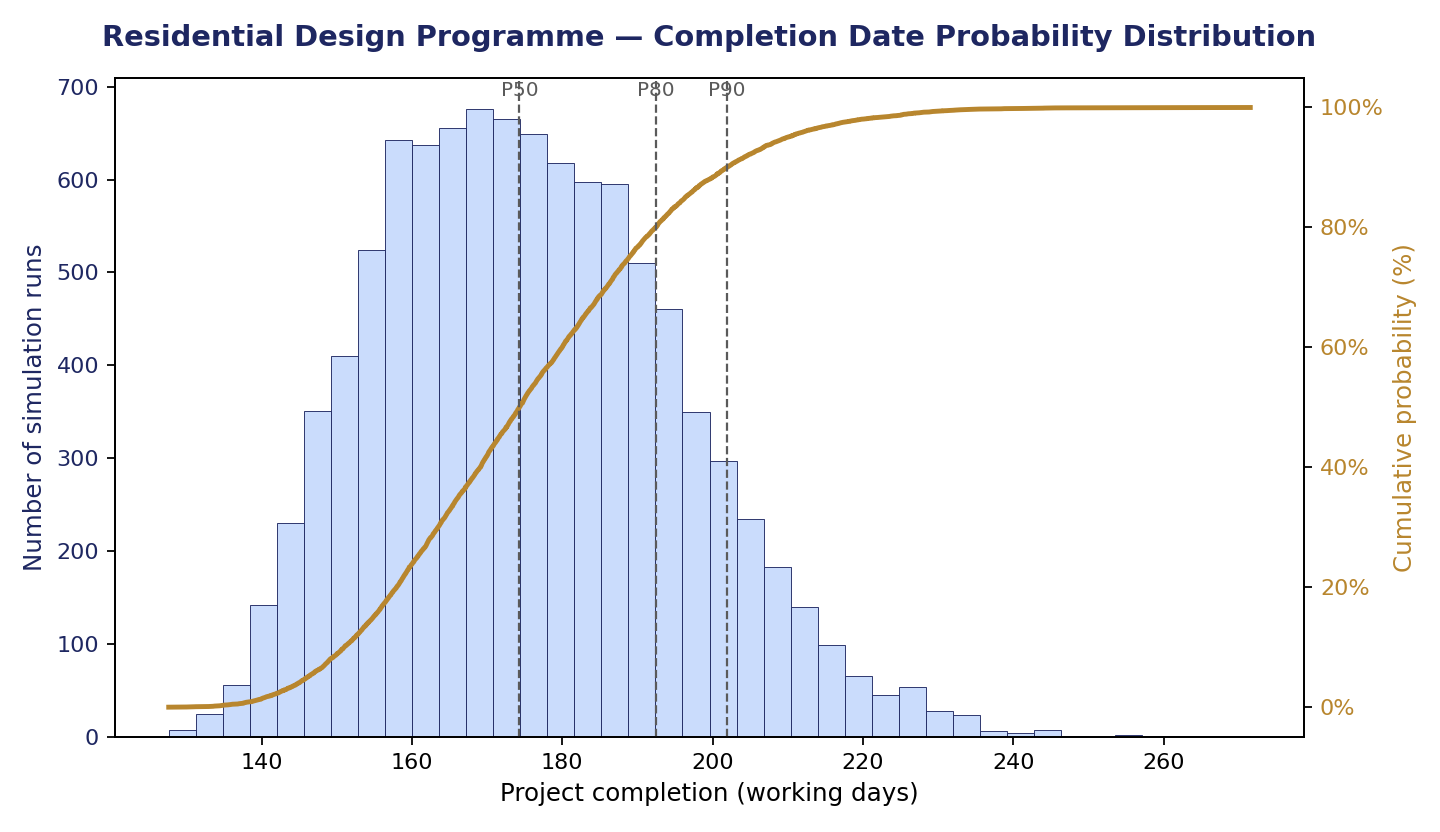
- How to read and interpret P50, P80, and P90 completion dates, probability curves, and sensitivity (tornado) charts
- How to translate simulation results into a completion date you can confidently commit to and defend, if you're ever asked to
Alignment with NSCA Performance Criteria
Directly Relevant to Real Registration and Practice Requirements:
This course develops knowledge and skills that map directly onto the Practice Management and Professional Conduct unit of competency in the AACA's 2021 National Standard of Competency for Architects, specifically:
PC 3 requires architects to understand and apply the principles of project planning, considering implications for stakeholders and project costs. This course teaches a rigorous, repeatable method for building the activity table and dependency logic that underpins any project plan.
PC 4 requires the ability to apply principles of project and staff planning and resource costs to establish realistic and achievable timeframes — the core subject of this entire course, which moves you beyond single-point estimates to a quantified, defensible timeframe.
PC 16 requires architects to understand and apply risk management and mitigation principles and strategies, including project risk, across architectural services. This course walks through building an ISO 31000-aligned risk register and applying it quantitatively to schedule outcomes.
PC 47 requires the ability to complete and communicate on-time, accurate documents for relevant stakeholders. This course teaches how to set and communicate realistic programme commitments to clients and stakeholders from the outset.
This course is designed to build knowledge and practical skills relevant to these performance criteria as part of your ongoing professional development. It is not a substitute for, or formal assessment against, AACA registration or accreditation requirements.
Find the full details about mapping in the following booklet!
What is the duration of the course?
What skills will I gain from this course?
How can I sign up for the course?
Do I receive certificate for this course?
Do I still need to engage a risk management specialist?
Not Ready to Enrol?
Stay Ahead of the Risk.
If you're considering improving your risk management capability but timing isn't right, leave your details below.
You'll receive priority updates, CPD announcements, and practical insights designed specifically for engineers, so when you're ready, you’ll be informed and prepared.
Enter your details to stay connected. You'll receive occasional updates about the Risk Management Processes course, professional insights, and future enrolment opportunities.
Receive Risk Management Insights & Course Updates
Join our professional update list to receive course updates, industry insights, CPD information, and early access opportunities.
Risk Management for Australian Architects & Engineers
August 2026 Edition - Short Tips
STAFF TURNOVER RISK
IN CONSTRUCTION-RELATED PROJECTS
The problem is hiding in plain sight.
Australian architectural firms are losing staff at rates exceeding 30% per year. Every departure costs a minimum of $10,000 in direct replacement costs and several times that when you factor in lost billable hours, stalled project milestones, and clients who quietly decide not to come back. For a practice of ten to twenty people, two or three concurrent departures in a single year is not an inconvenience. It is a financial and operational crisis.
And yet most firms respond to it the same way every time: advertise, interview, hire, onboard, repeat. No root cause analysis. No risk ownership. No measurement. The same problem, the same cost, year after year.
Here is how we solve it.
We treat staff turnover as what it actually is: a project risk, and we manage it with the same rigour we apply to programme delays, cost overruns, and NCC compliance failures.
Using AS/NZS ISO 31000:2018 and the PMBOK 7 Risk Performance Domain, we identify the twelve specific turnover risks operating inside a typical Australian architectural practice, score each one against probability and impact, assign a named owner, and implement targeted, evidence-backed responses.
The results are not theoretical. Structured career pathways reduce turnover from over 30% to under 6%. A formalised hybrid work policy cuts voluntary attrition by a third. Annual salary benchmarking eliminates the single most common reason top performers walk out the door. These are not perks or culture initiatives; they are risk treatments with measurable return.
The difference between a firm that manages this well and one that does is not luck. It is a documented process, run consistently, reviewed quarterly.
Download the full document for the complete risk register, scoring methodology, and your 90-day implementation plan
The link is below (Tip for August 2026).
Short Professional Articles Resources
Why "Design Only" Can Become Your Biggest Liability Risk
Many architects believe that providing design-only services reduces their professional liability.
In reality, the opposite is often true. This practical training presentation explains why design-only engagements can create significant contractual, insurance, and legal risks if they are not properly managed.
Through real Australian practice examples, you'll learn about procurement models, novation, professional indemnity insurance, contract vulnerabilities, and proven risk mitigation strategies that help protect both your practice and your reputation. Whether you're an architect, project manager, or construction professional, this course provides practical knowledge you can immediately apply to reduce risk and make better contractual decisions.
Forecasting Design Schedule Risk with Monte Carlo Simulation
Every residential design project starts with a promised completion date one number the client hears, remembers, and holds you to. Built the conventional way, that date is little more than a confident-sounding guess: it assumes nothing goes wrong, and it rarely survives contact with council assessments, late client sign-offs, or a structural report that arrives a week behind schedule.
This short CPD course teaches registered architects a better way. Using a real, fully worked residential design example, 22 activities, a seven-item risk register, and a genuine Monte Carlo simulation, you'll learn how to turn a single guessed date into a defensible, probability-based commitment, in minutes, using an AI assistant.
No coding. No specialist software. No consultant fee.
You'll walk away with a reusable, copy-paste AI prompt, a complete worked example, and a method you can apply to your very next project before you next quote a client a date you can't fully stand behind.
New Comprehensive Risk Processes Course
Risk Management Processes for Architects | 12 CPD |
Build stronger project outcomes with our Risk Management Processes for Architects course. Learn practical risk identification, qualitative and quantitative analysis, Monte Carlo simulation, response planning and monitoring, helping you make better decisions and manage uncertainty confidently.