Torque and Tension in Fasteners
Dec 30, 2025Torque and Tension in Fasteners for Heavy Industrial Structures and Mining Machinery
1. Introduction
In the mining industry, mechanical fasteners are far more than simple hardware components. Bolts, studs, nuts, and washers form the critical load paths that hold together crushers, mills, conveyors, stackers, reclaimers, screens, mobile equipment, steel structures, and transfer towers. The integrity of these systems depends directly on correct bolt tension, which is most commonly applied through controlled torque.
Failures related to improper bolt tightening are among the most frequent root causes of mechanical breakdowns in mining plants. These failures lead to unplanned shutdowns, safety incidents, accelerated fatigue damage, and catastrophic structural collapse in extreme cases. Understanding torque and tension is therefore not optional knowledge; it is a core engineering competency for designers, site engineers, supervisors, and maintenance personnel.
This handbook provides a practical yet rigorous engineering treatment of torque and tension in fasteners, with direct application to heavy industrial structures and heavy moving machinery used in mining.
2. Fundamental Concepts:
Torque vs Tension
2.1 What Is Torque?
Torque is the rotational force applied to a fastener during tightening. It is typically applied using tools such as torque wrenches, hydraulic tensioners, or impact tools (with control limitations).
Torque is expressed as:
T = Force × Lever Arm
In engineering practice, torque units are usually:
-
N·m (Newton-metres)
-
kN·m (for very large fasteners)
Torque itself does not hold the joint together. Instead, it is a means of creating bolt tension.
2.2 What Is Tension (Preload)?
When a bolt is tightened, it stretches elastically. This stretch creates an internal tensile force known as preload or bolt tension. The clamped components are compressed with an equal and opposite force.
This preload is the true holding force in a bolted joint.
Key point:
Torque is an indirect input. Tension is the functional outcome.
2.3 Why Torque Is a Poor Indicator of Tension
As highlighted in your reference material, torque does not directly measure bolt tension because:
-
85–90% of applied torque is lost to friction
-
Only 10–15% creates bolt stretch
Friction depends on:
-
Thread condition
-
Surface roughness
-
Coatings and plating
-
Lubrication
-
Reuse history
This is why identical torque values can result in widely different bolt tensions.
3. Importance of Correct Preload in Mining Applications
3.1 Joint Integrity Under Dynamic Loads
Mining equipment operates under:
-
Shock loading
-
Vibration
-
Reversing loads
-
Thermal expansion
Examples include:
-
Crusher mainframe bolts
-
Mill liner bolts
-
Conveyor pulley bearing housings
-
Structural connections in transfer towers
Adequate preload prevents:
-
Joint separation
-
Micro-slip
-
Fretting corrosion
-
Fatigue cracking
3.2 Over-Tightening vs Under-Tightening
Under-tightening risks:
-
Bolt loosening
-
Fatigue failure
-
Shear load transfer to the bolt shank
-
Structural instability
Over-tightening risks:
-
Yielding of the bolt
-
Thread stripping
-
Brittle fracture
-
Reduced fatigue life
Mining environments magnify these risks due to continuous operation and the high consequences of failure.
4. Bolt Strength, Proof Load, and Preload Selection
4.1 Yield Strength and Proof Strength
Yield strength (Sy):
Stress at which permanent deformation begins.
Proof strength (Sp):
The maximum stress a bolt can sustain without permanent deformation.
From your reference
Sp = 0.85 × Sy
This relationship is widely accepted for steel fasteners.
4.2 Recommended Preload
For mining and heavy industry, recommended preload values are:
Reusable joints:
Fi = 0.75 × At × Sp
Permanent joints:
Fi = 0.9 × At × Sp
Where:
-
Fi = preload force (N)
-
At = tensile stress area (mm²)
-
Sp = proof strength (MPa)
4.3 Tensile Stress Area (At)
The tensile stress area is not the shank area. It is defined by thread geometry and is obtained from standards such as ISO 898 or ASME B1.
Example:
For an M30 bolt:
At ≈ 561 mm²
(From standard tables)
5. Bolt Elongation Method (Preferred Method)
5.1 Why Elongation Is Superior
Measuring bolt elongation directly measures actual bolt stretch, which correlates directly to tension.
Used in:
-
Critical crusher joints
-
Large mill flange bolts
-
Structural anchor bolts
5.2 Elongation Formula
From your reference
δ = (Fi × l) / (A × E)
Where:
-
δ = bolt elongation (mm)
-
Fi = preload (N)
-
l = effective bolt length (mm)
-
A = bolt cross-section area (mm²)
-
E = Young’s modulus (≈ 200,000 MPa for steel)
5.3 Practical Mining Example
M36 bolt, Grade 10.9
At = 817 mm²
Sy = 940 MPa
Sp = 0.85 × 940 = 799 MPa
Reusable joint preload:
Fi = 0.75 × 817 × 799
Fi ≈ 489,000 N
If bolt length l = 300 mm:
δ = (489,000 × 300) / (817 × 200,000)
δ ≈ 0.90 mm
This elongation is what must be measured on site.
6. Torque-Based Tightening (Most Common in Mining)
6.1 Torque–Tension Relationship
T = K × Fi × d
Where:
-
T = tightening torque (N·m)
-
K = torque coefficient
-
Fi = preload (N)
-
d = nominal bolt diameter (m)
6.2 Torque Coefficient (K)
Typical values:
-
Black finish steel: K = 0.30
-
Zinc-plated: K = 0.20
-
Lubricated: K = 0.18
-
Cadmium-plated: K = 0.16
Mining practice must always state the lubrication condition.
6.3 Example Torque Calculation
Using previous M36 example:
d = 0.036 m
Fi = 489,000 N
Lubricated bolt → K = 0.18
T = 0.18 × 489,000 × 0.036
T ≈ 3,170 N·m
This value aligns with real mine-site torque tables.
7. Special Challenges in Mining Machinery
7.1 Vibration and Fatigue
High preload improves fatigue resistance by:
-
Preventing joint separation
-
Reducing the stress range in the bolt
This is critical in:
-
Vibrating screens
-
Crushers
-
Mobile plant frames
7.2 Large Diameter Bolts
Bolts above M42 often require:
-
Hydraulic torque wrenches
-
Hydraulic bolt tensioners
Manual torque wrenches become impractical and unsafe.
7.3 Re-Tightening and Reuse
Each tightening cycle changes the friction characteristics.
For reused bolts:
-
Reduce preload
-
Inspect threads
-
Replace if any yielding is suspected
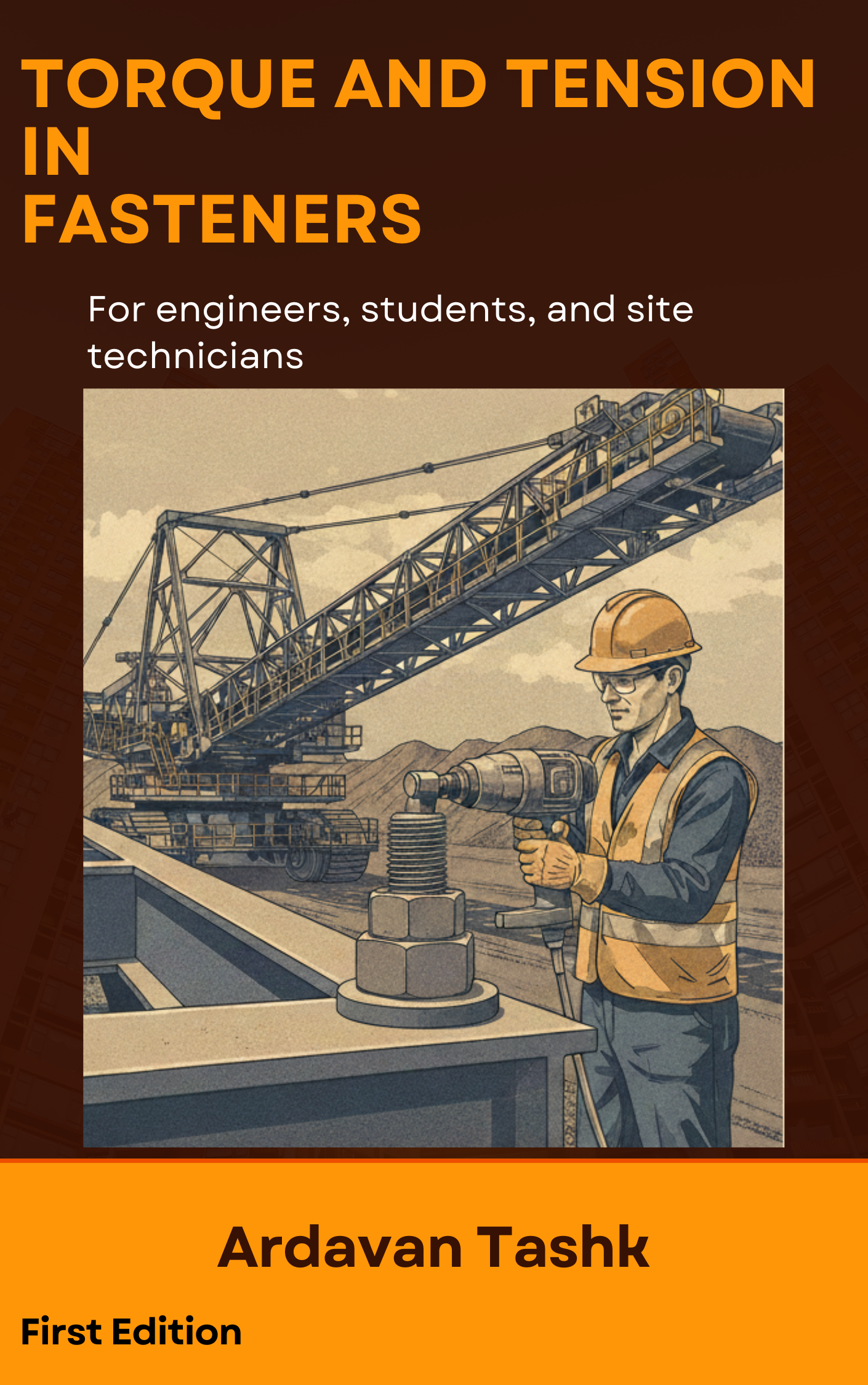
Torque and Tension in Fasteners for Mining and Heavy Industrial Applications
Book Overview
Torque and Tension in Fasteners for Mining and Heavy Industrial Applications is a practical, site-focused engineering handbook developed for professionals working with heavy structures and dynamically loaded machinery in the mining and resources industry. The book bridges fundamental bolted joint mechanics with real-world installation, inspection, and failure prevention practices, with strong emphasis on reliability, safety, and repeatability in harsh operating environments.
Length
The book spans approximately 75 pages, structured to support both structured learning and rapid on-site reference during maintenance, shutdowns, and commissioning activities.
Primary Focus
-
Fundamentals of torque, tension, and preload in bolted joints
-
Behaviour of fasteners under static, dynamic, and fatigue loading
-
Bolt, nut, and washer selection for heavy industrial applications
-
Tightening methods and tools (torque, torque-angle, hydraulic tensioning)
-
Effects of lubrication, friction, and surface condition
-
Inspection, verification, and quality control of bolted joints
-
Common bolting failures in mining equipment and how to prevent them
Applications include mills, conveyors, crushers, bins, hoppers, stackers, reclaimers, and wagon dumpers.
Learning Outcomes
After reading this book, the reader will be able to:
-
Understand the relationship between applied torque, friction, and resulting bolt tension
-
Select appropriate fasteners, tightening methods, and lubrication for critical joints
-
Apply engineering formulas to estimate preload, stiffness, and joint behaviour
-
Implement practical inspection and verification protocols on site
-
Identify common bolting failure modes and apply effective corrective actions
-
Communicate bolting requirements clearly within maintenance, shutdown, and project teams
Target Audience
-
Mechanical and structural engineers
-
Mining and heavy equipment engineers
-
Maintenance and reliability professionals
-
Site supervisors and technical specialists
-
Engineering students working with heavy machinery and structures
Overall Value
Rather than a purely theoretical treatment, this book serves as a hands-on engineering guide, grounded in the mining industry's experience. It provides engineers and technicians with practical tools, checklists, and decision frameworks to achieve consistent, safe, and reliable bolted joints in demanding industrial environments.