Monte Carlo Simulation in Construction
Aug 27, 2026
Monte Carlo Simulation in Construction:
A Practical Guide to Risk, Cost and Schedule Analysis
Construction projects are built around estimates, programmes and assumptions. However, construction outcomes are rarely certain.
Material prices can change. Labour productivity can vary. Weather can interrupt work. Approvals can take longer than expected. Subcontractors may not perform according to the original programme, and supply-chain problems can introduce unexpected delays.
This is where Monte Carlo Simulation in construction can provide a more realistic approach to project risk analysis.
Instead of asking, “What will the project cost?” or “When will the project finish?”, Monte Carlo Simulation asks a more useful question:
“What range of outcomes is possible, and how likely is each outcome?”
Monte Carlo Simulation is a probabilistic modelling technique that can be used to analyse uncertainty in construction costs, project durations, schedules and other variables. Research published by the University of Washington's 2025 Innovation in the Construction Industry project highlights its potential to improve risk visualisation, contingency planning and decision-making in construction.
What Is Monte Carlo Simulation in Construction?
Monte Carlo Simulation in construction is a quantitative risk analysis technique that repeatedly models a construction project using different combinations of uncertain inputs.
Rather than using one fixed value for each variable, the model assigns probabilities or probability distributions to uncertain factors.
For example, instead of assuming:
Excavation will take 10 days.
a probabilistic model might consider:
- 8 days as an optimistic outcome
- 10 days as the most likely outcome
- 15 days as a pessimistic outcome
The simulation then runs the project many times, using different combinations of these possible outcomes.
The result is not a single prediction. It is a distribution of possible project outcomes.
This allows a project team to examine questions such as:
- What is the probability of completing the project by the contractual date?
- What is the probability that the project will exceed the budget?
- How much contingency may be required?
- Which risks have the greatest effect on completion?
- What happens if material prices increase?
- How sensitive is the programme to weather or labour delays?
Why Is Monte Carlo Simulation Useful in Construction?
Traditional construction programmes often use deterministic durations.
For example:
| Activity | Planned Duration |
|---|---|
| Excavation | 15 days |
| Foundations | 20 days |
| Structure | 40 days |
| External works | 25 days |
| Finishes | 30 days |
The programme may therefore indicate a total duration of 130 days.
The problem is that 130 days is an estimate, not a certainty.
In reality, each activity has uncertainty.
Excavation might take 12–20 days. Concrete works might take 18–25 days. Finishes might take 25–40 days.
Monte Carlo Simulation incorporates this uncertainty into the analysis.
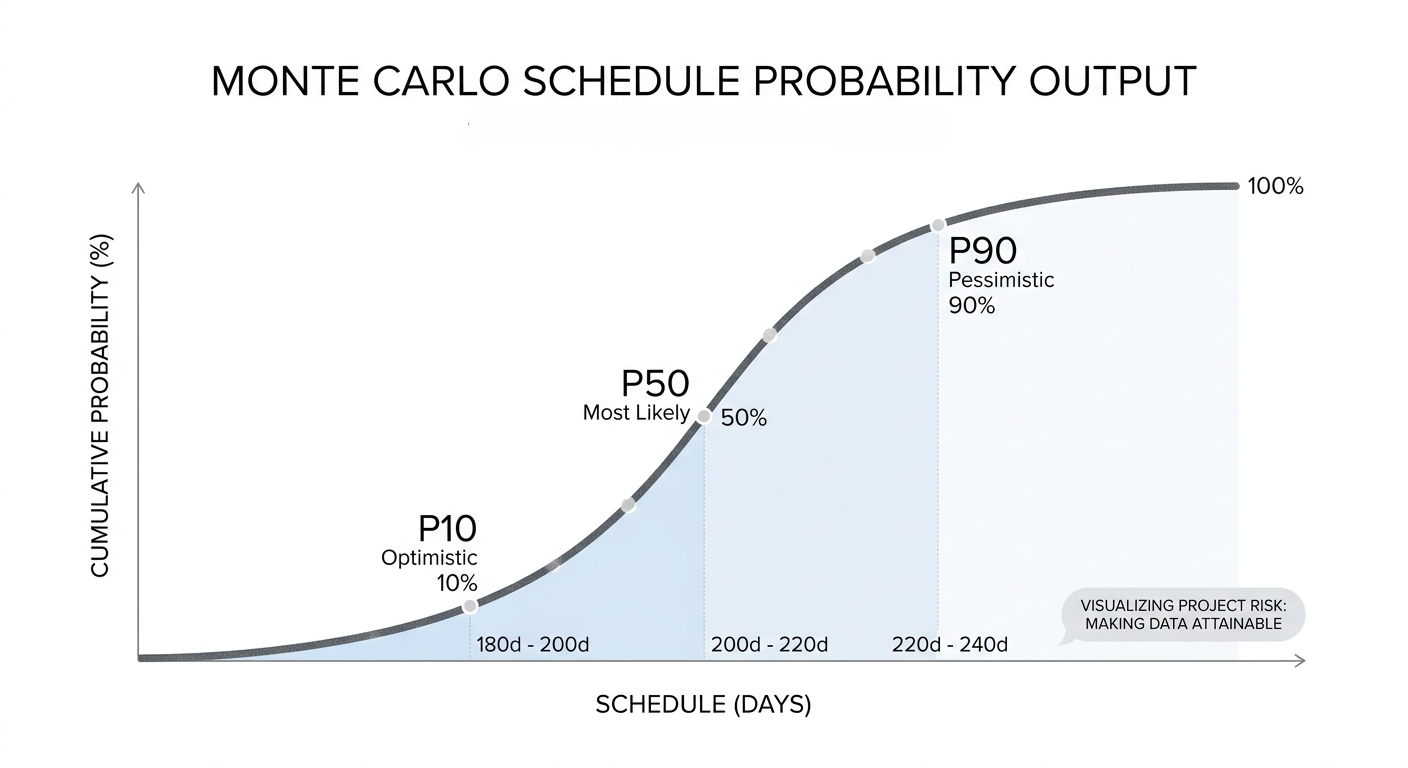
The resulting output could show something like:
- 10% probability of completion by Day 130
- 50% probability of completion by Day 142
- 80% probability of completion by Day 151
- 90% probability of completion by Day 158
This is much more informative than simply stating that the project duration is 130 days.
Monte Carlo Simulation vs Traditional Construction Estimating
The fundamental difference is deterministic versus probabilistic analysis.
Deterministic approach
A deterministic model normally uses one value:
Project duration = 130 days
or:
Project cost = $10 million
This approach is simple and familiar, but it can hide uncertainty.
Probabilistic approach
A Monte Carlo model produces a range of possible outcomes.
For example:
Project duration:
- P10 = 130 days
- P50 = 142 days
- P80 = 151 days
- P90 = 158 days
The P80 value means that, under the assumptions of the model, approximately 80% of simulated outcomes are at or below that duration.
This does not mean that Day 151 is guaranteed. It means the model estimates an 80% probability of achieving the duration.
That distinction is extremely important when using quantitative risk analysis in construction.
How Does Monte Carlo Simulation Work?
A simplified Monte Carlo Simulation follows several steps.
Step 1: Define the project objective
First, determine what you want to analyse.
For example:
- construction completion date
- total project cost
- project contingency
- cash flow
- labour requirements
- productivity
- procurement risk
The question being asked determines the structure of the model.
Step 2: Identify uncertain variables
The next step is to identify variables that could materially affect the result.
For a construction schedule, these could include:
- weather delays
- material delivery
- labour productivity
- subcontractor performance
- design changes
- approvals
- site conditions
- equipment availability
- rework
- inspection delays
For cost analysis, variables could include:
- material prices
- labour rates
- quantities
- escalation
- subcontractor costs
- variations
- waste
- productivity
- preliminaries
Step 3: Assign probability distributions
Instead of giving every variable a single value, probability distributions can be used to represent uncertainty.
Common distributions used in modelling include:
- triangular distribution
- normal distribution
- lognormal distribution
- uniform distribution
- beta distribution
- discrete probability distributions
For example, a triangular distribution might be appropriate when the project team knows an optimistic, most likely and pessimistic duration.
Step 4: Run the simulation
The computer randomly selects values from the defined probability distributions.
One simulated project might experience:
- normal material delivery
- good weather
- average labour productivity
- no major rework
Another simulation might experience:
- material delay
- poor weather
- below-average productivity
- additional rework
The process is repeated thousands of times.
The University of Washington construction example demonstrates this concept using an Excel-based model and 10,000 simulated construction outcomes.
Step 5: Analyse the results
The simulations are then converted into statistical outputs.
These can include:
- mean
- median
- standard deviation
- minimum
- maximum
- percentiles
- probability of achieving a target
- probability of exceeding a budget
- cumulative probability
The most useful result is often not the average.
It is the probability of achieving the project's required target.
Monte Carlo Simulation for Construction Schedule Risk
Schedule risk is one of the most practical applications of Monte Carlo Simulation.
Consider a project with a contractual completion date of 30 June.
A traditional programme might indicate that the project will finish on 25 June.
That appears comfortable.
However, a Monte Carlo analysis might reveal:
Probability of completing by 30 June = 42%
That changes the management conversation.
The project team can then investigate why the probability is so low.
The model may identify several major contributors:
- Structural works
- Long-lead materials
- Labour productivity
- Wet-weather exposure
- Commissioning
- Design information
The project team can then focus risk mitigation on the variables with the greatest influence on the completion date.
This is one of the major advantages of quantitative risk analysis: it helps distinguish important risks from merely numerous risks.
Monte Carlo Simulation for Construction Cost Risk
Monte Carlo Simulation can also be applied to construction cost forecasting.
Suppose a project has an estimated construction cost of $20 million.
A deterministic estimate may present:
Estimated cost = $20 million
But a probabilistic model could show:
| Outcome | Simulated Result |
| P10 | $19.2 million |
| P50 | $20.4 million |
| P80 | $21.6 million |
| P90 | $22.4 million |
This provides project stakeholders with a much better understanding of financial exposure.
Instead of asking:
“What is the project cost?”
the team can ask:
“What level of cost confidence do we require?”
For example, a client may decide that an 80% confidence level is appropriate for a particular stage of project planning.
The required contingency can then be considered in the context of the project's risk profile.
Construction Risk Management and Monte Carlo Analysis
Monte Carlo Simulation should not replace conventional construction risk management.
It should complement it.
A typical risk management process may include:
Risk identification → Risk assessment → Risk response → Monitoring → Quantitative analysis
Monte Carlo Simulation becomes particularly valuable when the project team needs to understand the combined effect of multiple uncertainties.
For example:
A project may have:
- 10-day potential procurement delay
- 5-day weather exposure
- variable labour productivity
- uncertain excavation conditions
- potential design changes
Looking at each risk independently does not necessarily tell the project team what the overall project exposure is.
Monte Carlo Simulation can combine these uncertainties and generate a distribution of possible project outcomes.
A Simple Construction Monte Carlo Example
Imagine a 20-week construction programme.
For simplicity, assume each week has a possibility of experiencing a delay.
A simplified model could consider:
- supply-chain disruption
- weather interruption
- labour productivity
- other minor disruptions
The simulation runs the project thousands of times.
One simulated project might experience only a few delays.
Another might experience several disruptions.
After 10,000 simulations, the results can be displayed as a probability distribution.
The resulting graph might show that:
- some projects finish close to the planned duration
- most projects experience some delay
- a smaller number experience substantial delays
- the probability of achieving the original programme decreases as the target becomes more aggressive
This is the central strength of Monte Carlo Simulation.
It makes uncertainty visible.
The University of Washington example demonstrates this principle through an Excel model of construction delays and shows how relatively small recurring disruptions can accumulate into significant project-duration impacts.
What Does a Monte Carlo Construction Model Need?
A useful construction Monte Carlo model normally requires four major components.
1. Input data
The model needs information about the variables being analysed.
Examples include:
- historical project data
- production rates
- previous project durations
- procurement records
- cost information
- expert judgement
2. Probability assumptions
Each uncertain variable needs an appropriate probability model.
Poor assumptions produce poor results.
This is sometimes described as:
Garbage in, garbage out.
A sophisticated simulation cannot compensate for unrealistic input assumptions.
3. Simulation engine
The model must repeatedly generate possible project outcomes.
This can be performed using:
- Excel
- specialist risk-analysis software
- Python
- MATLAB
- other statistical or project-management platforms
Excel can be useful for learning and relatively simple models because it is already familiar to many construction professionals. However, larger models can require specialist software or programming environments.
4. Interpretation
The final step is perhaps the most important.
A Monte Carlo model produces statistical information.
A construction professional must convert that information into a management decision.
The question is not simply:
“What does the simulation say?”
The more useful question is:
“What should the project team do differently because of what the simulation shows?”
Limitations of Monte Carlo Simulation in Construction
Monte Carlo Simulation is powerful, but it is not a crystal ball.
There are several important limitations.
1. The model depends on the quality of its assumptions
If the probability distributions do not represent the real project, the outputs may be misleading.
2. Historical data may be limited
Many construction businesses do not have sufficiently structured historical data to establish reliable probability distributions.
3. Correlation between risks can be difficult
Risks are not always independent.
For example, extreme weather could simultaneously affect:
- productivity
- material deliveries
- site access
- plant
- safety
- programme duration
Treating these variables as independent may distort the result.
4. Statistical outputs require interpretation
A project team unfamiliar with probability distributions may misunderstand P50, P80 or P90 results.
5. A simulation does not eliminate risk
Monte Carlo Simulation identifies and quantifies uncertainty.
It does not prevent the risk from occurring.
The value comes from using the information to improve planning and risk response.
How Monte Carlo Simulation Can Improve Construction Decision-Making
The greatest benefit of Monte Carlo Simulation is not the mathematics.
It is the quality of the decision-making that can follow the analysis.
For example, if a simulation shows only a 35% probability of meeting a contractual completion date, the project team has an opportunity to intervene.
Possible responses might include:
- increasing resources
- changing sequencing
- accelerating procurement
- increasing schedule float
- engaging additional subcontractors
- changing construction methodology
- ordering long-lead materials earlier
- increasing contingency
- revising the programme
The simulation therefore becomes a decision-support tool rather than simply a statistical exercise.
Monte Carlo Simulation and Quantitative Risk Analysis
Monte Carlo Simulation is particularly relevant to quantitative risk analysis.
Qualitative risk analysis generally categorises risks according to factors such as:
- likelihood
- consequence
- severity
- priority
Quantitative risk analysis goes further by attempting to measure the potential effect of uncertainty numerically.
Monte Carlo Simulation is one of the techniques that can be used to perform this type of analysis.
For construction professionals, this distinction is important.
A risk register may tell you:
“There is a high risk of procurement delay.”
A quantitative simulation may help answer:
“How much could procurement uncertainty affect the probability of achieving the required completion date?”
That is a much more decision-oriented question.
Is Monte Carlo Simulation Practical for Builders?
Yes, but the level of sophistication should match the project.
A small residential construction project may not justify a highly complex probabilistic model.
A major commercial, infrastructure or high-value development project may benefit substantially from quantitative risk modelling.
The key is proportionality.
A practical construction risk model should be:
- understandable
- transparent
- based on defensible assumptions
- relevant to the project
- regularly updated
- connected to actual management decisions
There is little value in creating an extremely sophisticated model that nobody on the project team understands or uses.
Monte Carlo Simulation in the Australian Construction Industry
For Australian construction businesses, Monte Carlo Simulation can be particularly relevant where projects are exposed to significant uncertainty in:
- material costs
- labour availability
- subcontractor performance
- procurement
- weather
- approvals
- design changes
- programme constraints
- site conditions
- project interfaces
For NSW builders, engineers, project managers and construction professionals, quantitative risk analysis can form part of a broader approach to construction risk management and project planning.
It should, however, be used alongside appropriate contractual, technical, safety and regulatory processes rather than as a substitute for them.
Monte Carlo Simulation in Excel
Excel is often a practical starting point for learning Monte Carlo Simulation.
A simple model can use functions such as:
RAND()
to generate random values and conditional logic to determine whether particular events occur.
A basic construction model might contain:
Parameters → Simulation → Summary
The Parameters sheet contains assumptions.
The Simulation sheet performs repeated trials.
The Summary sheet calculates:
- average duration
- median duration
- standard deviation
- minimum and maximum
- probability of meeting the target
- percentile outcomes
This approach is useful for understanding the mechanics of probabilistic modelling.
However, construction professionals should be cautious about relying on a simple spreadsheet model for high-value decisions without validating the assumptions, formulas, dependencies and correlations.
What Construction Professionals Should Take Away
Monte Carlo Simulation does not predict the future.
It does something more useful.
It helps construction professionals understand the range of possible futures.
A deterministic programme might say:
“The project will finish in 140 days.”
A probabilistic analysis can say:
“There is a 50% probability of finishing by approximately Day 140, an 80% probability by approximately Day 150, and a 20% probability of exceeding Day 160.”
That additional information can fundamentally change how a project team approaches:
- contingency
- programme management
- procurement
- resource planning
- cost forecasting
- risk response
- stakeholder communication
The construction industry has traditionally relied heavily on deterministic estimates and schedules. Research into Monte Carlo Simulation suggests that probabilistic approaches have significant potential, although practical adoption remains constrained by data quality, technical capability, workflow integration and organisational culture.
Frequently Asked Questions About Monte Carlo Simulation in Construction
What is Monte Carlo Simulation in construction?
Monte Carlo Simulation in construction is a quantitative risk analysis method that repeatedly models uncertain project variables to estimate the probability and range of possible outcomes for cost, time, schedule or other project objectives.
What is Monte Carlo Simulation used for in construction?
It can be used for construction schedule risk analysis, cost forecasting, contingency analysis, productivity modelling, procurement risk, project duration analysis and quantitative risk assessment.
What is the difference between Monte Carlo Simulation and a normal construction programme?
A conventional programme generally uses fixed durations and assumptions. Monte Carlo Simulation introduces uncertainty and generates a probability distribution of possible project outcomes.
Can Monte Carlo Simulation be done in Excel?
Yes. Excel can be used to build relatively simple Monte Carlo models using random-number functions, formulas and repeated simulations. More sophisticated projects may require specialist risk-analysis software or programming tools.
What does P80 mean in construction risk analysis?
P80 generally refers to an outcome at or below which approximately 80% of simulated results fall, assuming the model and probability assumptions are appropriate. For example, a P80 project duration represents a duration with approximately 80% simulated confidence of achieving that duration or better.
Is Monte Carlo Simulation suitable for small construction projects?
It can be, but the analysis should be proportionate to the project's size, complexity and risk exposure. A simple model may be more appropriate than a highly sophisticated simulation for a small project.
Conclusion
Monte Carlo Simulation in construction provides a structured way to analyse uncertainty rather than hiding it behind a single cost estimate or completion date.
Its greatest value is not simply producing graphs or statistical distributions. The real value is helping construction teams understand the probability of different outcomes and make better-informed decisions about programme, cost, contingency and risk response.
As construction projects become increasingly complex and data-driven, probabilistic methods such as Monte Carlo Simulation provide an important additional layer of analysis alongside traditional estimating, scheduling and risk management.
For construction professionals who want to move beyond simply identifying risks and begin quantifying their potential impact, Monte Carlo Simulation is an important technique to understand.