A Structured Approach to Maintaining Clarity and Control in Architectural Projects
Many project issues don’t come from major errors, but from loss of clarity in scope, responsibilities, and decisions
This course is designed for experienced architects seeking a more structured way to manage coordination, documentation, and project risk across all stages of delivery
Earn Your Badge From Formal Online Training
Including 8 separate modules with 7 separate certificates
14-Day Cooling-Off Period
Start NowProfessional Growth Through Practical Learning
Gain practical skills through structured modules, case studies, interactive quizzes, and expert support designed to elevate your confidence, decision-making, and professional impact
The course is designed to be completed flexibly alongside professional work commitments

12 CPD Aligned
Formal training with 7 certificates

PMBOK® Framework
Structured learning aligned with global project standards.

Start When You’re Ready
Online, self-paced, start immediately after enrolment & online support with 12 months access.

Help Is Always Here
Instructor guidance is available anytime for any question.

Quiz Driven
268 quizzes to reinforce and apply knowledge. That enhances the training.

Simulated Examples
Case studies from Australian architectural and construction projects.
Modular Certificates for Smarter CPD Management
Issuing certificates per CPD module offers students flexibility to manage annual CPD requirements, adjust workloads, and track progress. It simplifies compliance documentation, supports audit readiness, and boosts motivation through milestone recognition. Modular certificates also enhance career portability, allowing professionals to showcase targeted skills.
This format aligns with global best practices, encourages spaced learning, and protects against record loss, making it a more convenient and strategic choice for learners.
After completing each module, please send us a request to receive your certificate.
If you've completed more than one module at the same time, simply list all the module numbers you'd like certificates for. We'll issue separate certificates for each and send them all to you together.
Module 1: Foundation
[ M1 + M2 = 2.5 CPD ]
Module 2: Plan Risk Management
[ M1 + M2 = 2.5 CPD ]
Module 3: Identify Risk
[ 2 CPD ]
Module 4: Perform Qualitative Risk Analysis
[ 1 CPD ]
Module 5: Perform Quantitative Risk Analysis
[ 2 CPD ]
Module 6: Plan Risk Responses
[ 1.5 CPD ]
Module 7: Implement Risk Responses
[1.5 CPD ]
Module 8: Monitor Risk
[ 1.5 CPD ]
CPD Eligibility Statement
This course is designed to support architects in meeting their Continuing Professional Development (CPD) requirements.
The course delivers new knowledge and skills relevant to architectural practice and is mapped to the 2021 National Standard of Competency for Architects (NSCA).
Architects are responsible for self-determining whether this course is relevant to their individual learning needs and for recording CPD activities in the NSW ARB My CPD portal.
Learning outcomes
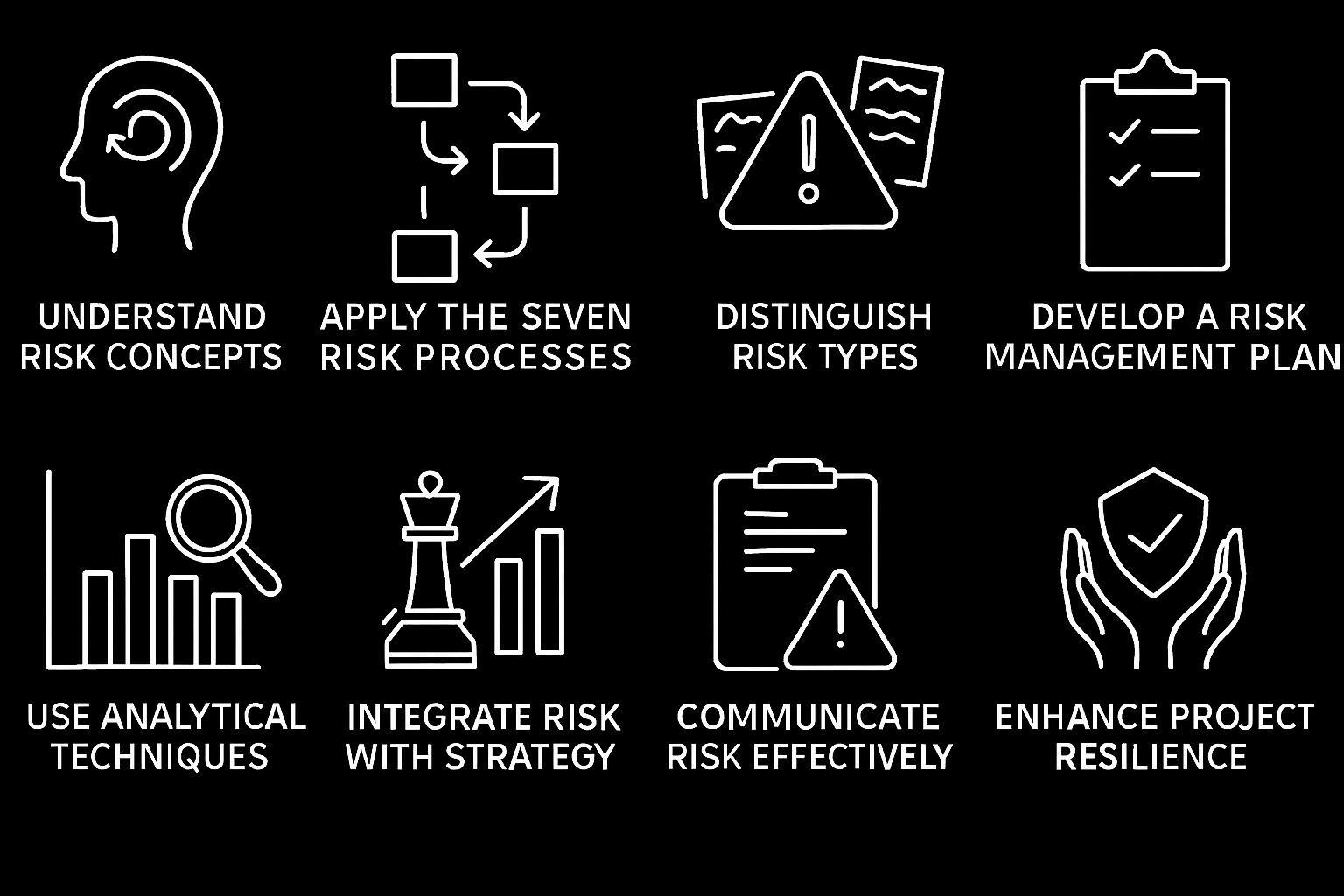
During this 9-Module Course, you'll learn to:
- Grasp the definitions of individual and overall project risk, risk appetite, tolerance, and thresholds.
- Learn to plan, identify, analyse (qualitative and quantitative), respond to, implement, and monitor risks throughout the project lifecycle.
- Recognise event-based risks, variability risks, ambiguity risks, and emergent risks and tailor responses accordingly.
- Define methodology, roles, tools, and reporting structures for managing risk on any project.
- Apply probability-impact matrices, expected monetary value (EMV), decision trees, and sensitivity analysis to evaluate risk exposure.
- Align risk responses with project objectives, stakeholder expectations, and organisational governance frameworks.
- Learn escalation paths, reporting formats, and stakeholder engagement strategies to ensure transparency and alignment.
- Build contingency plans, empower teams, and monitor early warning signs to adapt to unknowns and reduce impact.
Download the comprehensive syllabus booklet for more details on the outcomes.
Alignment with NSCA Performance Criteria
The course content supports the acquisition and application of competencies required under the NSCA 2021. Specifically:
Practice Management & Professional Conduct (PC1–PC16)
- PC2 – Quality assurance systems: reinforced through structured and continuous risk management procedures that maintain quality and compliance across the project lifecycle.
- PC3 – Project planning: addressed through systematic integration of risk assessment and control measures into project management planning.
- PC7 – Legal and regulatory frameworks: embedded through lessons on managing planning approvals, statutory obligations, contract risk, and safety-in-design responsibilities.
- PC9 – Procurement risks: covered through examples of supplier evaluation, contract-based risk transfer, and insurance strategies.
- PC16 – Risk management and mitigation: comprehensively addressed across all modules, incorporating principles of resilience, professional liability, and proactive mitigation planning.
Project Initiation & Conceptual Design (PC17–PC35)
- PC19 – Project feasibility and risks: supported through qualitative and quantitative risk analysis that evaluates site constraints, client objectives, and contextual uncertainties.
- PC22 – Conflict of interest and professional risk: integrated through modules on ethical obligations, stakeholder management, and transparency in project governance.
- PC24 – Development options and risks: reinforced with analytical tools that evaluate design alternatives, procurement approaches, and delivery pathways.
Design Delivery & Construction Phase Services (PC48–PC60)
- PC59 – Risks in documentation and record management: addressed through structured record-keeping, maintenance of risk registers, performance logs, and lessons-learned documentation.
Find the full details about mapping in the following syllabus booklet!

The Syllabus Booklet
We collect your name, email, and occupation to provide access to the syllabus, understand our professional audience, and communicate with you about relevant education.
Please complete the form to download and save the booklet.
It is provided to assist you in deciding whether this course is suitable for you.
What is the duration of the course?
What skills will I gain from this course?
How can I sign up for the course?
Do I receive certificate for this course?
Do I still need to engage a risk management specialist?
You can start today
You’ve seen how this course is structured and how it meets CPD requirements.
Take the next step and enrol to develop a practical,
A repeatable risk management approach you can apply across your projects.
Start the course todayNot Ready to Enrol?
Stay Ahead of the Risk.
If you're considering improving your risk management capability but timing isn't right, leave your details below.
You'll receive priority updates, CPD announcements, and practical insights designed specifically for architects, so when you're ready, you’ll be informed and prepared.
Enter your details to stay connected. You'll receive occasional updates about the Risk Management Processes course, professional insights, and future enrolment opportunities.
Receive Risk Management Insights & Course Updates
Join our professional update list to receive course updates, industry insights, CPD information, and early access opportunities.
Risk Management for Australian Architects
October 2026 Edition - Short Tips
Decision Backlog — Why It Helps
The Decision Backlog is a simple but powerful project-management tool designed to make an often-overlooked source of project delay visible: unresolved decisions.
On construction and architectural projects, delays are not always caused by physical work. A project can be waiting for a council assessment, an engineer’s design, a client selection, an approval, or a response to an RFI. When these decisions remain scattered across emails, meeting minutes, RFIs and conversations, it becomes difficult to see what is actually holding the project back.
The Decision Backlog creates one visible place to capture these outstanding decisions. More importantly, it identifies what the decision is, who owns it, the required deadline, what options are available, and its current status.
This helps project teams distinguish between decisions that are merely administrative and those that have a high impact on the project programme, cost, procurement or construction documentation. High-impact decisions can then be identified and escalated early rather than discovered when they have already created a delay.
Used consistently during weekly project reviews, the backlog also creates accountability. Instead of simply asking, “What are we waiting for?”, the team can ask:
- Who owns this decision?
- What is blocking it?
- What happens if it slips?
- Do we still need the decision?
The result is better visibility, clearer ownership and earlier intervention. It can reduce avoidable waiting time, prevent decisions from being forgotten and help project teams maintain momentum.
In simple terms: the Decision Backlog turns invisible project delays into visible, manageable actions.
Download the full document here!
The link is below (Tip for October 2026).
Short Professional Articles | Architecture Projects |
Why "Design Only" Can Become Your Biggest Liability Risk
Many architects believe that providing design-only services reduces their professional liability.
In reality, the opposite is often true. This practical training presentation explains why design-only engagements can create significant contractual, insurance, and legal risks if they are not properly managed.
Through real Australian practice examples, you'll learn about procurement models, novation, professional indemnity insurance, contract vulnerabilities, and proven risk mitigation strategies that help protect both your practice and your reputation. Whether you're an architect, project manager, or construction professional, this course provides practical knowledge you can immediately apply to reduce risk and make better contractual decisions.
Forecasting Design Schedule Risk with Monte Carlo Simulation
Every residential design project starts with a promised completion date one number the client hears, remembers, and holds you to. Built the conventional way, that date is little more than a confident-sounding guess: it assumes nothing goes wrong, and it rarely survives contact with council assessments, late client sign-offs, or a structural report that arrives a week behind schedule.
This short CPD course teaches registered architects a better way. Using a real, fully worked residential design example, 22 activities, a seven-item risk register, and a genuine Monte Carlo simulation, you'll learn how to turn a single guessed date into a defensible, probability-based commitment, in minutes, using an AI assistant.
No coding. No specialist software. No consultant fee.
You'll walk away with a reusable, copy-paste AI prompt, a complete worked example, and a method you can apply to your very next project before you next quote a client a date you can't fully stand behind.
Mastering Expected Value (EV) in Project Risk Management
Expected Value (EV) is a practical quantitative risk management technique that helps project professionals turn uncertainty into measurable information for better decision-making. Instead of relying only on qualitative risk ratings or “gut feel”, EV combines the probability of different outcomes with their potential cost or schedule impact to produce a weighted measure of risk.
In this short course, you will learn the fundamentals of Expected Value and how to apply the EV formula to real project risk scenarios. The study demonstrates how EV can be used to assess schedule uncertainty, financial consequences, contingency requirements and risk mitigation decisions.
You will also explore an important aspect of quantitative risk analysis:
low-probability, high-impact events.
A risk that appears unlikely can still make a significant contribution to the overall expected impact of a project. The course also introduces risk pooling and explains why correlation between projects, locations, clients or supply chains can undermine diversification.
By completing this short study, you will be better equipped to quantify risks, challenge assumptions, compare mitigation costs with potential impacts, and communicate risk information more objectively to project stakeholders and decision-makers.
The accompanying 21-minute video provides a concise explanation of the key concepts, while the downloadable PDF gives you a practical reference that you can revisit when applying EV to your own project risk register.