Product, Project, and Project Management Life Cycle
What You'll Learn
In this training, you will:
- Understand the distinct phases and importance of each life cycle.
- Learn how to apply these life cycles in various project and product scenarios.
- Gain insights into how these life cycles interrelate and impact project and product success.
Join us as we explore these essential life cycles and equip ourselves with the knowledge to navigate and manage projects and products more effectively.
This short training will delve into three fundamental life cycles crucial to understanding and managing successful projects and products, the Product Life Cycle, the Project Life Cycle, and the Project Management Life Cycle.
While these terms may sound similar, each plays a distinct role in different contexts. Let's break them down:
Product Life Cycle
The product life cycle refers to the stages a product goes through from its inception to its decline. This cycle typically includes:
- Introduction: Launching the product into the market.
- Growth: Increasing market acceptance and sales.
- Maturity: Sales growth slows as the product reaches peak market penetration.
- Decline (Obsolescence): Sales decrease as the product becomes outdated or less desirable.
Understanding the product life cycle helps businesses strategise marketing, production, and product development efforts to maximise a product's market presence and profitability.
We usually talk about things related to project management; the product life cycle may be related to project management too as its process may contain a few projects.
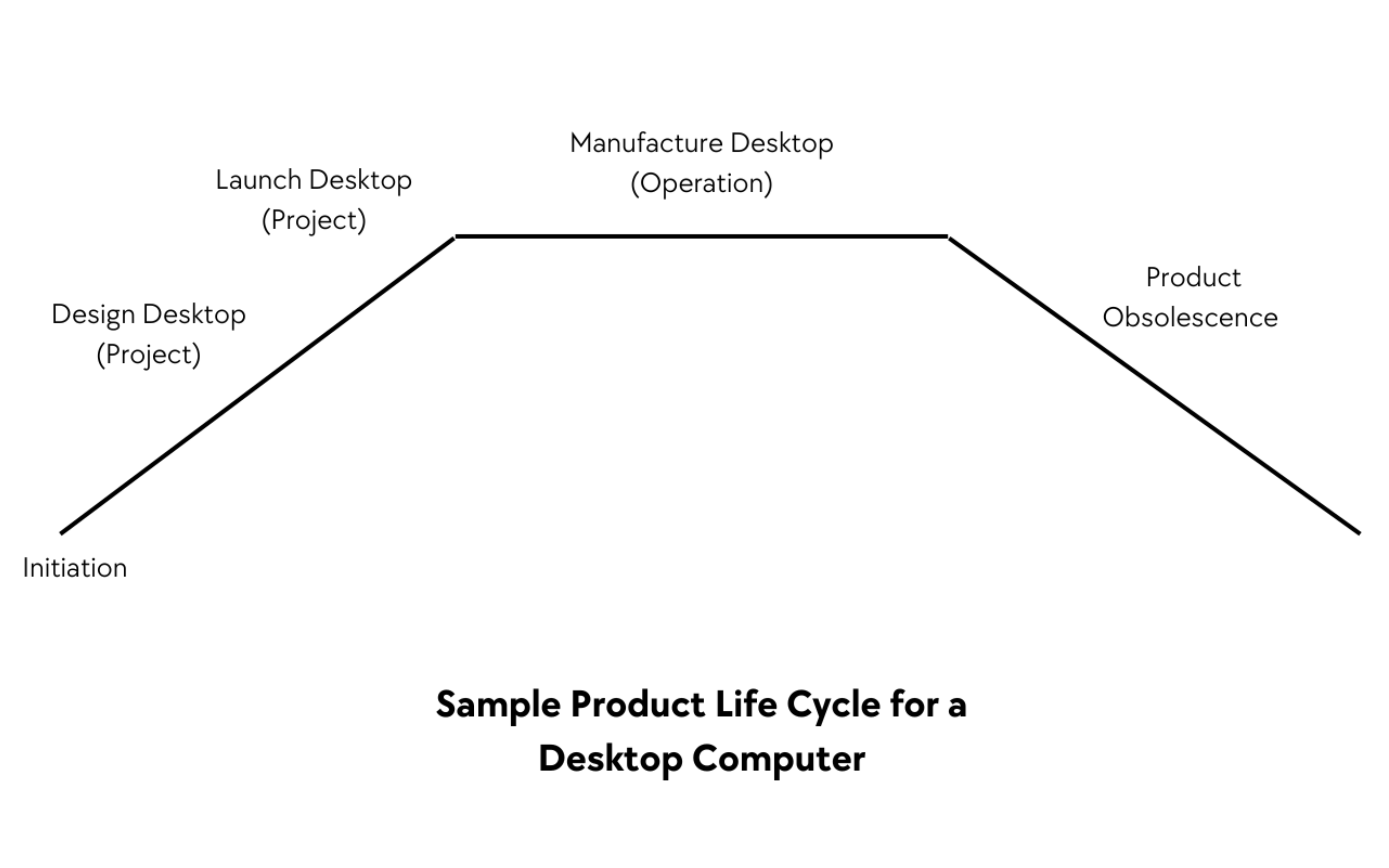
A product life cycle may have several projects (hence multiple project life cycles) and operations.
The product phases are generally sequential and non-overlapping, e.g., a project undertaken to design a new desktop computer is only one phase in the product life cycle.
Project Life Cycle
Includes all the phases required for a project to create a product, service, or result, e.g., in IT projects, a sample project life cycle may include initiation, High Level Design, Low Level Design, Unit Testing, Integration Testing, User Acceptance Testing, and Rollout. The project life cycle is industry-specific and can be different for each project.
The following are features of a life cycle:
1- The project life cycle includes starting the project, organizing and preparing, carrying out the project work, and closing the project.
2- It includes the transitional activities at the beginning and end of the project (so, provides the link with the ongoing operations of the performing organisation).
3- The project life cycle may be just a phase of the product life cycle.
4- Subprojects within projects have their distinct life cycle.
5- The project life cycle is divided into project phases. This provides a formal basis for control and reduces the degree of uncertainty. A management review is held at the end of a phase and often includes a decision regarding whether to start the activities of a subsequent phase.
6- Phase end reviews are also called phase gates, kill points, decision gates, milestones, phase exits, or toll gates. These are points to reassess project progress and to obtain authorisation to close the current phase and/or to start the subsequent phase. A phase-end review can also be used to determine the project if necessary.
7- The three basic types of phase-to-phase relationships are a) sequential, b) overlapping, and c) iterative.
8- Project governance provides a method to control the project and ensure its success. This should fit within the larger context of the program or the organization sponsoring it.

Factors that increase with project duration, then decrease sharply when the project nears completion are
· Cost of project
· Staffing levels

Factors that increase with project duration are:
· Probability of successfully completing the project.
· Cost of changes.
· Cost of error correction.

Factors that decrease with project duration are:
· Uncertainty about the project.
· Ability of stakeholders to influence the final characteristics of the project’s product.
· Ability of stakeholders to influence the cost of the project’s product.
Project management Life Cycle
This is not industry-specific and is valid for all projects.
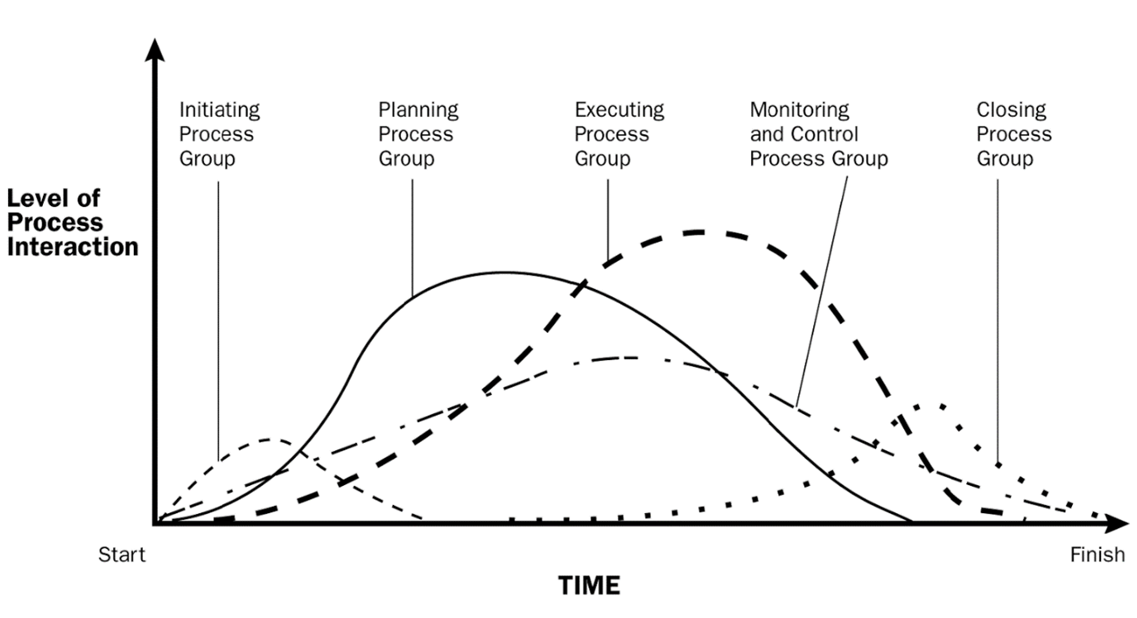
The project management life cycle includes five project management process groups.
· Initiating
· Planning
· Executing
· Monitoring and controlling
· Closing
The different project management process groups interact and overlap as shown below:

Responses