Expert Judgment in Risk Planning
Sep 01, 2026
Architectural practice in Australia sits at a complex intersection of design innovation, local council regulations, and fluctuating market conditions.
Navigating this landscape successfully requires more than creative intuition; it demands strategic risk planning. In accordance with PMBOK® standards, the first and most intuitive tool for this is Expert Judgment.
What is Expert Judgment in Risk Planning?
Expert judgment means consulting professionals with deep, relevant experience to identify project-specific risks and shape your risk management plan. Rather than offering mere opinions, these specialists provide crucial contextual intelligence rooted in years of pattern recognition.
Who Qualifies as an Expert?
On an architectural project, experts are diverse and specialised:
- Senior Architects: Who have successfully delivered similar project typologies, such as major civic centres or educational facilities.
- Code and Heritage Consultants: Essential for navigating complex heritage constraints and local planning guidelines.
- Procurement Specialists: Who understand local tendering risks and market fluctuations.
- Community Liaisons: Offering strategic insight into public sentiment and neighbourhood resistance.
For example, an experienced urban designer might anticipate approval delays from public hearings, while a services engineer can flag supplier bottlenecks that threaten the construction schedule.
Three PMI® Focus Areas for Expert Knowledge
According to PMI® standards, expert knowledge is highly valuable in three specific areas:
- Familiarity with Organisational Risk Approaches: Senior voices help leverage existing enterprise risk protocols and historical lessons learned.
- Tailoring the Plan to the Project: Different project types carry distinct risk tolerances. For instance, an art museum may be risk-averse regarding materials but open to program innovations, whereas a temporary retail pavilion may have the exact opposite risk profile.
- Understanding Typology-Specific Risks: Experts recognise typical risk trends. A student housing project typically faces tight schedules and fixed budgets, whereas a high-end private residence is far more prone to scope creep.
Actionable Practice Tips
- Build an Expert Roster: Create a go-to directory in your firm for zoning, school boards, and fast-track scheduling specialists.
- Mentor Emerging Professionals: Ensure younger architects sit in on expert calls to observe how veteran practitioners identify and challenge planning assumptions.
- Engage Experts Early: Don't wait for things to go wrong. Bring external experts in during the planning stage to protect your design integrity.
Integrating these expert-driven strategies is a core skill for any leading architect.
To master these risk management principles, continuous professional development is essential.
Course Information & Syllabus Download
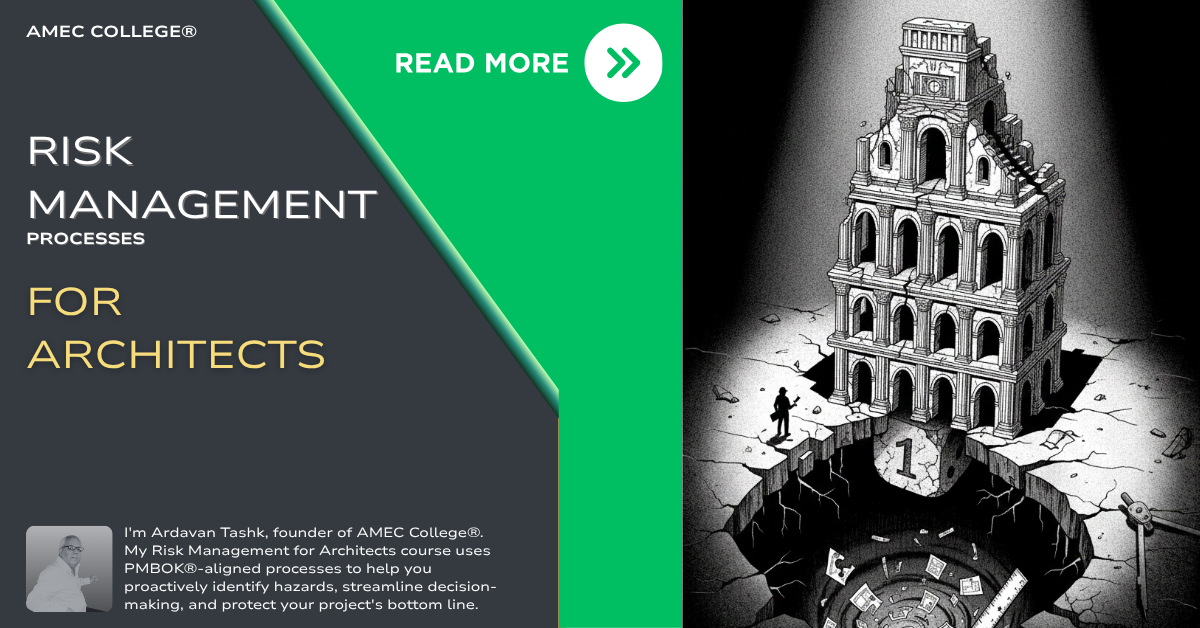
Click on the image below to explore and find out more about our 12-hour online training in regard to risk management for architects that is aligned with 12 CPD. The link will take you to the landing page of the course where you can download the full syllabus, find details, and see how it has been mapped to NSCA 2021.